Pipeline Assessment Services
for Commercial, Industrial, and Municipal Clients

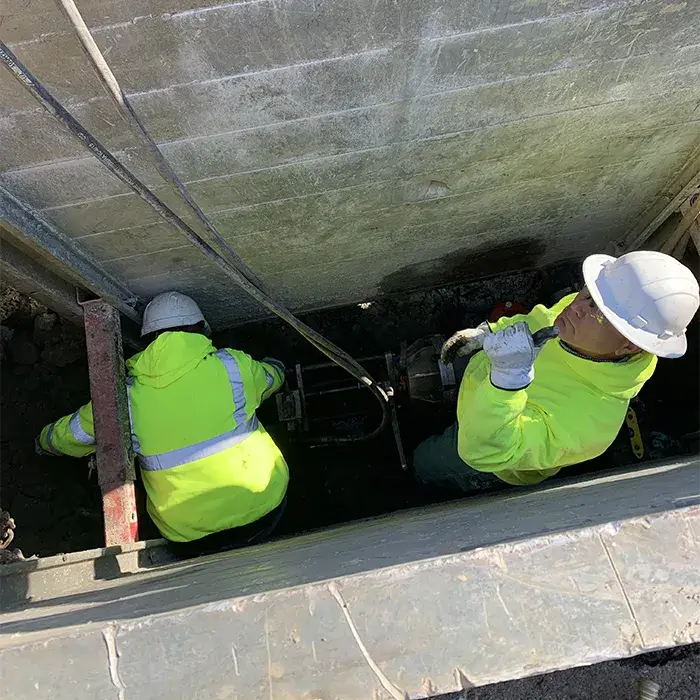
If you encounter an issue, such as a pipeline leak or blockage, we’ll assess the situation to determine the root cause and severity. Armed with this information, we’ll develop a customized solution to address the problem efficiently, minimizing disruption to your operations and preventing further damage.
While this is an oversimplification of the assessment step, the work we do here plays a vital role in maintaining and optimizing water and wastewater infrastructure. During the assessment phase, we adopt a proactive, data-driven strategy to effectively manage your assets, significantly improve service reliability, and drastically minimize non-revenue water losses to contribute to the long-term sustainability of your future water supplies.
Pipeline Assessment Technology
At OES Underground, we never stop moving forward. We employ the latest in pipeline assessment technology, while continuing to evaluate emerging technologies. Today, we are proud to employ In-line, Free Floating, External, and CCTV Inspection Technologies.
Key Benefits of OES’s Advanced Pipeline Inspection Technology
Early Detection
Provides a complete pipeline condition inspection and assessment
Reduced Water Loss
Minimizes water loss and operational costs.
Environmental Impact
Conserves water resources and reduces environmental impact.
Precise Data & Measurement
Measures the degradation of the pipeline systems.
Non-Disruptive
Minimal disruption to operations and infrastructure.
In-Line Inspection Technologies Used in Our Pipeline Assessment Services
In-line inspection (ILI) is a non-destructive testing method used to assess the condition of pipelines internally. It involves sending intelligent devices, sometimes referred to as “pigs,” through the pipeline to collect data on its internal state. The ILI pig is inserted into the pipeline at a designated launch point. As it travels through the pipeline, its sensors collect data on the pipeline’s condition. The collected data are analyzed to identify potential issues and generate detailed reports. These assessments can measure healthy wall thickness, the condition of a joint, as well as the ovality, axial deformation, leaks, wire breaks, plots XYZ locations, contamination or debris at the bottom of the pipe, and gas pockets. Based on the inspection results, OES quickly and accurately provides a maintenance or repair plan.
Here at OES, we don’t use just any pigs to perform these complex and critical recon missions. Rather, we prefer Acquaint’s Acquarius and Acquaint’s Aquabrella in-line inspection technology. The Acquaint technology delivers data-driven insight into the current condition of the pipeline. The inspection data will give us the critical information we need to recommend improvement decisions such as pipeline rehabilitation or replacement, as well as the areas we need to prioritize.
Pipeline Assessment Services Using Free-Floating Acoustic Technology
Pipeline assessment services using free-floating acoustic technology detect gas pockets, temperature variations, pressure changes, and sediment buildup within the pipeline. At OES, we use the Pipers® free-floating, acoustic-based inspection tool to assess the condition of your water, wastewater, and gas pipelines.
This technology requires a minimum 3-inch outlet or flange removal for insertion of the inspection sphere. The inspection sphere is inserted into the pipeline through an existing access point, such as a valve, cleanout, or launching station. Typically, two spheres are launched within 15 minutes of each other (when possible) to gather real-time operational data on force mains. The device(s) are propelled by the flow of the product within the pipeline (water, oil, gas, etc.).
This “free-floating” nature eliminates the need for external propulsion or tethering, making it suitable for long distances and complex pipeline networks. As the device travels through the pipeline, it collects various data using onboard sensors. The primary data collected is acoustic, focusing on leak noises and air pocket locations. This is often ideal as it requires minimal disruption to operations.
External Inspection Technologies
Used in Pipeline Assessment Services
OES also provides external pipeline inspection technology using the The Acquaint PipeScanner, Electromagnetic Bracelet Probe™, and HULO.ai software.
The Acquaint PipeScanner is an ultrasound-based tool loaded with sensors to detect pipe wall thickness, corrosion, leaching, and deterioration. It was specifically developed to inspect pipelines with very little disturbance, from the outside. It is best used on steel, cast iron, asbestos cement, and HPDE/PVC pipelines. PipeScanner provides high-accuracy, non-destructive AC testing, vital for aging pipeline management.
For rapid detection of internal and external corrosion damage, OES uses the Electromagnetic Bracelet Probe™ to provide fast and economical inspection of bare, coated, or wrapped force mains and potable water systems. It adapts to any size ductile-iron, cast-iron, or steel pipe starting at a 6-inch diameter. The system utilizes a low-frequency electromagnetic field that penetrates through the pipe wall, and records and displays data immediately for instant analysis to show the size and degree of damage, trends in wall thickness reductions, and erosion.
Finally the HULO.ai software works with existing pressure and flow sensors already installed within the water distribution network. HULO.ai’s AI algorithms continuously analyze sensor data in real-time. This allows for immediate detection of anomalies that might indicate a leak. The system is adaptable and can work with various pressure and flow sensor types, regardless of the manufacturer. By analyzing pressure and flow patterns, the AI can identify unusual fluctuations that could signify a leak. It also incorporates historical data into its analysis for more accurate leak detection and integrates with Geographic Information Systems (GIS) data to pinpoint the location of potential leaks within the network. The HULO.ai then prioritizes leaks based on severity and location, helping water utilities address the most critical issues first.
CCTV Inspection Technologies
Used in Our Pipeline Assessment Services
Lastly, OES uses CCTV Inspection Technologies such as the Aries Pathfinder CCTV and the Deep Trekker PIVOT ROV to ensure your pipelines are completely and thoroughly inspected.
Aries Pathfinder CCTV is a compact portable system that inspects pipes from 6-inch to 120-inch, potable water. The system uses mounted cameras with 360º rotation, LED lighting, 120X zoom, and an exclusive camera lens cleaning system with field replaceable wipers to maximize productivity.
Deep Trekker PIVOT ROV inspects pipes 24-inches and larger, tanks and other subaqueous structures. Its fully immersible camera provides 200º range of motion, improved viewing, operating, and data recording. The system is powerful, with a six thruster configuration which allows the inspection system to move and pivot effortlessly even under strong currents. The sensor integrations and software advances allow for semi autonomous navigation. The system has a 4K camera and ultra-wide angle which provides for clarity whether the water is crystal clear or murky.